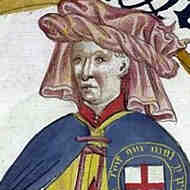
DE STAFFORD, Ralph KG, Sir
- Born: 24 Sep 1301, Tunbridge, Staffordshire, England
- Marriage (1): DE HASTANG, Katherine before 9 Feb 1327
- Marriage (2): AUDLEY, Margaret before 6 Jul 1336
- Died: 31 Aug 1372, Tonbridge, Kent, England at age 70
General Notes:
Sir Ralph "1st Earl of Stafford 2nd Lord Stafford" de Stafford KG (Knight of the Garter).
Research Notes:
https://www.wikitree.com/wiki/Stafford-78
----
Biography
European Aristocracy
Sir Ralph Stafford was a member of the aristocracy in England.
Ralph de Stafford[1]
Ralph was the son of Edmund de Stafford.[1]
At the time of Ralph's birth, on 24 September 1301, the Staffords exercised considerable influence in the west midlands, but had yet to assume the prominent role in national affairs that fell to them as a result of his own success as a soldier, administrator, and courtier. The bulk of their estates lay in Staffordshire and Warwickshire, with a few additional holdings in Oxfordshire and Lincolnshire, and generated an annual income of about £200 net. This was not enough to support a senior member of the English baronage, although Edmund de Stafford had sufficiently distinguished himself in the Scottish wars of Edward I to merit a personal summons to parliament. The path of advancement through military service was followed with distinction by his son, whose lasting achievement was to elevate his family to the ranks of the higher nobility.
Having lost his father as a child, Ralph Stafford had come of age and entered his estates by December 1323. He spent his youth in the society of his mother's Staffordshire relatives and of her second husband, a local landowner named Thomas Pipe. Stafford's first known experience of royal service occurred in 1325, when he, his younger brothers, and their stepfather joined the retinue of his maternal uncle, Ralph, second Lord Basset of Drayton. Soon, however, he grew more independent. He was made a knight-banneret in January 1327, being recruited to fight against the Scots shortly afterwards. His support for the plot to free the young Edward III from the control of his mother's lover, Roger Mortimer, earned him the king's lasting gratitude, and marked the beginning of what was to become a close personal relationship. Mortimer's arrest at Nottingham Castle during the parliament of October 1330 enabled Edward to seize the reins of power himself.
Per Tudor Place:
Knight of the Garter. Earl of Stafford in 1350. Fought in the Battle of Crecy and Battle of Sluys. Served in the Scotch and French wars and in important diplomatic missions in European countries."
Per GeneaJourney:
In Apr 1325, he was in the King's service, with his mother and her second husband, and his own brothers, in the company of Ralph, 2nd Lord Basset of Drayton and Constable of Dover Castle. He was made Knight Banneret 13 Jan 1326/27, and on 6 Apr 1327 was summoned to serve against the Scots. He was summoned to Parliament from 29 Nov 1336 to 25 Nov 1350, and served in Scotland in 1336 and 1337. He was in France with the King, returning 29 Nov 1339, and on 23 Jun 1340 was present at the battle of Sluys. In 1342 he sailed to Brittany and took part in the siege of Vannes, where he was captured, and later exchanged for another prisoner. In Apr 1344 he was in Gascony with 3 bannerets, 20 knights, 92 esquires, and 90 archers, and in Oct 1346 was appointed Seneschal of Aquitaine. He was a Knight of the Garter 23 Apr 1348, as one of the founders of that order. On 6 Sep 1348, he was granted for life 600 marks p.a. for his stay for life with the King with 60 men-at-arms. He was present at the naval battle off Winchelsea in Aug 1350, and was created Earl of Stafford 5 Mar 1350/51. He was among the leaders of the King's expedition to France in Oct 1355, and in Oct 1360 was in the vanguard of the army under the Duke of Lancaster, and joint marshal with the Earl of Warwick. In Aug 1360 he was appointed, with others, to treat for peace with France, and was a party to the treaty of Bretigny. He was in Ireland from Sep 1361 to Feb 1361/62, and crossed to France with the King in Oct 1369.
He married firstly, about 1326-27, Katherine, dau of Sir John Hastang, and secondly, before 6 Jul 1336, Margaret, daughter of the Earl of Gloucester, Hugh de Audley. He survived his second wife by 24 years. On 6 Jul 1336, a commission had been appointed to enquire into a complaint by Hugh de Audley, that Ralph de Stafford and others, mostly his relatives, had abducted his daughter, Margaret, and married her against his will.
Marriage
Married
Katherine de HASTANG: bef 9 Feb 1326/7
Joan Stafford
Margaret Stafford[2]
Margaret de Audley: Children of Sir Ralph Stafford and Margaret de Audley:[3]
Ralph,
Hugh,
Beatrice,
Joane,
Elizabeth
Margaret.: Sir John Stafford, knt., of Amelcote and Bromshull, Staffordshire, who was living in 1361, married as his second wife the Lady Margaret, daughter of Sir Ralph Stafford, K.G., and one of the original founders of that Order, second Baron Stafford, and who was subsequently raised to the Earldom 5 March, 1351, and died in 1372; by his wife Margaret, only daughter and heiress of Hugh de Audley, Baron Audley. He had issue by this marriage a son and heir named Humphrey.[4]
Thomas
Catherine[5]
Corbet Inheritance
On 24 September, 21 Edward III [1347], at Salop, an Inquisition regarding Beatrice, late the wife of Peter Corbet of Caus, found she died on 28 August last, and by a fine levied in the king's court at York, Hugh de Bergam, chaplain, surrendered properties including the manor of Caus to Peter Corbet and Beatrice his wife, and the heirs of their bodies, with remainder to the right heirs of Peter; Peter was the son of Peter son of Thomas Corbet; Peter predeceased his wife Beatrice and they had no children, so Peter's heirs were Ralph de Stafford aged 36 years, Margaret wife of Robert de Harleye aged 46, and Elizabeth wife of Edmund de Cornubia aged 42 years; Margaret being the firstborn daughter of Brian son of Walter son of Emma younger daughter of Thomas Corbet; Elizabeth was Margaret's younger sister; Ralph was the son of Edmund son of Nicholas son of Alice daughter of Thomas Corbet, sister of Emma and Peter, wife of Robert de Stafford.[1]
Burial
Sir Ralph de Stafford died testate August 31, 1372 and was buried with his second wife Margaret at Tonbridge Priory (Priory of St. Mary Magdalene) at Tonbridge, Kent, at the feet of her parents.
Research Notes
Removed Ralph Stafford-78 & Margaret de Audley-130 (both b. abt. 1300) as parents of
Edmund Stafford_De-1 (b. abt. 1270) <he is the father of Ralph>
John Stafford-713.
William DeStafford-13 (1306). <Bairfield-1 00:10, 3 May 2014 (EDT)>
Sources
? 1.0 1.1 1.2 J E E S Sharp and A E Stamp, Calendar of Inquisitions Post Mortem and other Analogous Documents Preserved in the Public Record Office. Vol IX Edward III, (London: His Majesty's Stationery Office, 1916), 83-84, e-book Internet Archive (https://archive.org/details/cu31924011387879/page/34/mode/1up : accessed 11 September, 2022). Abstract No 50. Beatrice, Late the Wife of Peter Corbet of Caus.
? Richardson, Douglas, Plantagenet Ancestry: A Study In Colonial And Medieval Families, p. 247-248. 2nd Edition, 2011, retrieved 2014-05-03, amb.
? Burke's, p.488
? The Strife of the Roses and Days of the Tudors in the West, p. 140. by W.H. Hamilton Rogers, F.S.A., amb
? Richardson, p. 247-248
See also:
Transactions of the Bristol and Gloucestershire Archaeological Society for 1884-1885 Edited by Sir john Maclean, F.S.A. Vol IX. Page 195.pedigree chart.
Royal Ancestry 2013 D. Richardson Vol. V p. 9-11
Oxford Dictionary of National Biography
Geneajourney.com
Tudor Place website
The Strife of the Roses and Days of the Tudors in the West, by W.H. Hamilton Rogers, p. 140
Wikipedia:Ralph_de_Stafford,_1st_Earl_of_Stafford
Beltz, George. Memorials of the Most Noble Order of the Garter (William Pickering, London, 1841) Page 33-6
----
https://en.wikisource.org/wiki/Dictionary_of_National_Biography,_1885-1900/Stafford,_Ralph_de
Dictionary of National Biography, 1885-1900, Volume 53
----
STAFFORD, RALPH de, first Earl of Stafford (1299\endash 1372), elder son of Edmund, lord de Stafford (d. 1308), and Margaret, daughter of Ralph, lord Basset (d. 1299), of Drayton, Staffordshire, and granddaughter of Ralph Basset (d. 1265) [q. v.], was born in 1299, being nine years old at his father's death. He had livery of his lands 6 Dec. 1323. Having been made a knight-banneret on 20 Jan. 1327, he served in that and the following year against the Scots. Joining himself to William, lord Montacute (1301\endash 1344) [q. v.], he swore in 1330 to maintain the quarrel of the lords against Roger (IV) de Mortimer, fourth earl of March (1287?\endash 1330) [q. v.] In 1332 he was appointed one of the guardians of the peace for Staffordshire (Cal. Pat. Rolls, p. 276). In April he was about to go beyond sea on the king's business (ib. p. 297), and in the summer took part in the expedition of Edward de Baliol [q. v.] into Scotland, where he served in the ensuing years, being there with his second wife, Margaret, in October 1336. In November of that year he received a summons to parliament, and on 10 Jan. 1337 was appointed steward of the king's household and a privy councillor (Doyle). From 1338 to 1340 he served with the king in Flanders. It is not always easy to be certain about his actions, for Froissart occasionally confuses him with his younger brother, Sir Richard Stafford (see Froissart, iv. 60 and 293, v. 201 and 400, ed. Luce), who in 1337 was sent with others on an embassy to the counts of Hainault and Gueldres, and also to the Emperor Lewis (ib. i. 361, 368), and had a share in the victory of Cadsant (ib. p. 408), and was in 1339 in the king's army at Vironfosse (ib. p. 469). Lord Stafford accompanied Edward on his hurried return to England on 30 Nov. 1340, and was sent by the king to Canterbury with a summons to John de Stratford [q. v.], the archbishop, to appear before him (Fœdera, ii. 1148). In the summer of 1342 he undertook to lead reinforcements to the king's troops in Brittany (ib. p. 1201), and sailed in joint command on 14 Aug. (Murimuth, p. 125). The expedition, of which the Earl of Northampton was in chief command, relieved Brest, and the English, after burning sixty French galleys, landed and overran the country, and, having sent back their ships to England to convey the king, laid siege to Morlaix, and on 30 Sept. defeated Charles of Blois, who marched to its relief. After the king's arrival Stafford took part in the siege of Vannes, and, advancing too eagerly to meet a sally, was taken prisoner, and many of his followers were also taken or slain (Froissart, iii. 25). He was exchanged for Olivier de Clisson, and was one of the English lords who in January 1343 assisted at the arrangement of the truce at Malestroit. On 20 May he was sent with others on an embassy to Clement VI with reference to a peace, and on 1 July to treat with the Flemings and the German princes (Fœdera, ii. 1224, 1227). He also in this year accompanied Henry of Lancaster, earl of Derby (afterwards duke of Lancaster) [q. v.], in an expedition intended for the relief of Lochmaban Castle (Walsingham, i. 254). He took part in the tournament held at Hereford in September 1344.
On 23 Feb. 1345 Stafford was appointed seneschal of Aquitaine, and after Easter embarked at Bristol with fourteen ships laden with troops and landed at Bordeaux. Having been joined by Derby about 1 July, he took part in the earl's campaign in Gascony, commanded the attack by water at the taking of Bergerac on the Dordogne, was constantly with the earl, and, in conjunction with Sir Walter Manny [q. v.], acted as one of his marshals. Sir Richard Stafford was also prominent among the English leaders, was at the siege of Bergerac, commanded the garrison at Liborne, and assisted in the relief of Auberoche. After the surrender of Aiguillon in December, Derby appointed Lord Stafford governor of the place in order that he might operate on the Lot while he himself attacked La Réole (Froissart, vol. iii. pref. p. xx), where Sir Richard was with him at the surrender of the place in January 1346. In March Lord Stafford signified his wish to resign the office of seneschal, and Edward wrote to Derby bidding him if possible to induce him to continue in office (Fœdera, iii. 73). Probably about the beginning of April the Duke of Normandy (afterwards King John of France) advanced with a large army to the siege of Aiguillon. Stafford had repaired the fortifications as well as he could, and where in one place the town lay open is said to have raised a barrier of wine-casks filled with stones (Knighton, col. 2589); the garrison was strong, and he defended the town valiantly (Avesbury, p. 356). Froissart assigns the chief part in the defence to Sir Walter Manny, and it is probable that Stafford left the place some time before the siege was raised, which was not until 20 Aug.; for he certainly fought in the division commanded by the Prince at Creçy on the following Saturday, 28th (Chandos Herald, l. 127; according to Froissart, this was his brother Sir Richard, see iii. 169, 408, but the Herald is the better authority). His brother Richard was also in the battle, and was afterwards sent by the king with Reginald, lord Cobham, to count the slain (ib. pp. 190, 432). Lord Stafford took part in the siege of Calais, and in February 1347 was sent by the king and council on a mission to Scotland with reference to the trial of the Earls of Menteith and Fife (Cal. Doc. Scotland, p. 270). Returning to the English camp, he was present at the surrender of Calais, and, as one of the king's marshals in conjunction with the Earl of Warwick, received the keys of the town and castle (Froissart, iv. 63; according to another recension of the 'Chroniques,' ib. p. 293, this is said to have been done by Sir Richard, who was also at the siege, but this is probably a mistake). The king granted him some property in the town (ib. p. 65). He was one of the negotiators of the truce made near Calais on 28 Sept. (Fœdera, iii. 136). During 1348 he was one of the original knights or founders of the order of the Garter, became one of the sureties for the Earl of Desmond [see under Fitzthomas or Fitzgerald, Maurice], received a grant of 573l. for his expenses in France, and contracted to serve the king during his life with sixty men-at-arms for a yearly stipend of 600l. He took part in the naval victory of L'Espagnols-sur-mer in August 1350 (Froissart, iv. 89), and in October was commissioned to treat with the Scots at York (Fœdera, iii. 205).
On 5 March 1351 the king created him Earl of Stafford (Doyle). Having been appointed lieutenant and captain of Aquitaine on 6 March 1352, he proceeded thither, and in September defeated the French forces from Agen, taking captive, along with seven knights of the company of the star, a noted leader named Jean le Meingre or Boucicaut, for whose capture he received the next year 1,000l. from the exchequer (Geoffrey le Baker p. 12; Issues of the Exchequer, p. 159). During a long session of the justices in eyre at Chester he joined the Prince of Wales and others there in 1353 in order to protect them, and afterwards, by the king's orders, returned to Gascony (Knighton, col. 2606). He joined the expedition fitted out by the Duke of Lancaster in the summer of 1355 to aid the king of Navarre, which was finally abandoned, and the earl sailed later with the king to Calais, and took part in Edward's campaign in northern France [see under Edward III]. Returning to England with the king, he accompanied him in his campaign in Scotland, which lasted until the spring of 1356. Meanwhile his brother Sir Richard followed the Prince of Wales into France in 1355, was sent by him with letters to England in December, rejoined his army, and fought at Poitiers on 19 Sept. 1356 (Avesbury, pp. 436, 445; Geoffrey le Baker, pp. 130, 297; Froissart, v. 31). In 1358 the earl received custody of the young Earl of Desmond's lands in Ireland. Both he and Sir Richard having accompanied the king in his expedition to France in October 1359, a sudden attack was made upon the earl's quarters on 26 Nov. when he was in the neighbourhood of Rheims, but he repulsed it with signal success (Knighton, col. 2621). He was one of the commissioners that drew up the treaty of Bretigni on 11 May 1360. In 1361 he accompanied Lionel (afterwards duke of Clarence) [q. v.] in his expedition to Ireland. In that year his brother Sir Richard was seneschal of Gascony, and held that office until 8 June 1362 (Fœdera, iii. 628, 653). The earl is said to have again served in France in 1365 (Dugdale), and in 1367 contracted during his life to serve the king in peace or war with a hundred men-at-arms, at a yearly stipend of one thousand marks from the customs of the ports of London and Boston (Fœdera, iii. 821). Meanwhile in 1366 his brother Sir Richard was appointed to go on an embassy, accompanied by his son Richard, to the papal court. Emaciated and worn out with old age and constant military service, the earl died at his castle of Tunbridge, Kent, on 31 Aug. 1372, and was there buried.
Stafford is much praised for his valour and daring. He was a benefactor to the priory of Stone, Staffordshire, founded by his ancestor, Robert de Stafford, in the reign of Henry I (Monasticon, vi. 226, 231), gave the manor of Rollright, Oxfordshire, to the priory of Cold Norton in that county (ib. p. 421), and about 1344 founded a house of Austin friars in Stafford (ib. p. 1399). He married (1) a wife named Katherine; and (2) before 10 Oct. 1336 Margaret, daughter and heiress of Hugh de Audeley, earl of Gloucester, who died 7 Sept. 1347. By her he had two sons\emdash the elder, Ralph, who married Maud, elder daughter of Henry of Lancaster [see under Henry of Lancaster, first Duke of Lancaster], and died before 1352, leaving no issue, and Hugh (see below)\emdash and four daughters.
The earl's brother Sir Richard married Matilda, widow of Richard de Vernon, and daughter and coheiress of William de Camville, baron Camville of Clifton, Staffordshire, and, receiving that lordship by his marriage, was styled Sir Richard Stafford of Clifton, and in 1362 is described as baron (Fœdera, iii. 657). The date of his death has not been ascertained. He left a son Richard, who was summoned to parliament as Baron Stafford of Clifton from 1371 to 1379, and died in 1381, leaving by his first wife, Isabel, daughter of Sir Richard de Vernon of Haddon, two sons\emdash Edmund de Stafford [q. v.], bishop of Exeter, and Sir Thomas Stafford.
Hugh de Stafford, second Earl of Stafford (1342?\endash 1386), second son of Ralph, first earl, was born about 1342, and served in the king's campaign in France in 1359. Having entered the retinue of the Prince of Wales, he was with him in Aquitaine, 1363\endash 6, followed him in his Spanish expedition, and was one of a party sent to reconnoitre the enemy (Chandos Herald, l. 2461). On 8 Jan. 1371 he received a summons to parliament as Baron de Stafford (Doyle), and on the death of his father on 31 Aug. 1372, his elder brother (see above) having died previously, succeeded as second Earl of Stafford. At that date he was setting out on the abortive expedition undertaken for the relief of Thouars. He accompanied John of Gaunt [q. v.] in his invasion of France in 1373. In 1375 he took part in the campaign of the Duke of Brittany and the Earl of Cambridge in Brittany, and towards the close of the year was made a knight of the Garter. He belonged to the court party, but nevertheless, on the meeting of the 'Good parliament' in April 1376, was one of the four earls appointed, with other magnates, to confer with the commons, and was a member of the standing council proposed by the commons and accepted by the king. On the meeting of the parliament of January 1377 he was again appointed member of a committee of lords to advise the commons (Rot. Parl. ii. 322, 326; Chron. Angliæ, lxviii. 70, 113; Stubbs, Const. Hist. i. 429, 432, 437). At the coronation of Richard II on 16 July he officiated as carver, and in October was appointed of the privy council for one year. Making himself spokesman for the discontented lords in 1378, he reproached Sir John Philipot (d. 1384) [q. v.] for defending the commerce of the kingdom without the sanction of the council, but Philipot answered him so well that he was forced to be silent. He was a member of the committee appointed in March 1379 to examine into the state of the public finances, and in 1380 of that appointed to regulate the royal household (Rot. Parl. iii. 57, 73). Froissart says that he took part in the Earl of Buckingham's campaign in France (Chroniques, ii. 95, ed. Buchon; but if this is correct there is a confusion in the passage between the earl's wife and Philippa, the daughter of Enguerrand de Couci by Isabella, daughter of Edward III; compare Walsingham, i. 434, and Fœdera, iv. 91). On 1 May 1381 he was appointed a commissioner for settling quarrels in the Scottish marches. He and his eldest son, Sir Ralph Stafford, one of the queen's attendants and a great favourite with her and the king, whose companion he had been from boyhood, marched northward with the king's army in 1385. While the army was near York, Sir Ralph was slain by Sir John Holland [see Holland, John, Duke of Exeter and Earl of Huntingdon]. The earl demanded justice of the king, and Richard having promised that it should be done, he continued his service with the army. It was evidently in consequence of this loss that the earl went a pilgrimage to Jerusalem in 1386, making his will at Yarmouth on 15 April, before starting. He died at Rhodes, on his homeward journey, on 26 Sept., and his body having been brought to England by his squire, John Hinkley, it was buried in Stone Priory (Dugdale, Baronage, i. 162; Monasticon, vi. 231). He married Philippa, second daughter of Thomas de Beauchamp, earl of Warwick (d. 1369), who predeceased him, and had by her, besides Sir Ralph, four sons\emdash Thomas who succeeded him as third Earl of Stafford, and died in 1392; William, fourth earl, who died in 1395; Edmund, fifth earl, who was killed in the battle of Shrewsbury on 21 July 1403, fighting on the king's side, and was father of Humphrey Stafford, first duke of Buckingham [q. v.]\emdash and three daughters, Margaret, wife of Ralph Neville, first earl of Westmorland [q. v.]; Catherine, wife of Michael de la Pole, third earl of Suffolk, and Joan, married after her father's death to Thomas Holland, duke of Surrey [q. v.]
[Murimuth, Avesbury, Walsingham (all Rolls Ser.); Geoffrey le Baker, ed. Thompson; Knighton, ed. Twisden; Froissart, ed. Luce (Société de l'Histoire), and ed. Buchon (Panthéon Litt.); Chandos Herald's Le Prince Noir, ed. Michel; Cal. Pat. Rolls; Cal. Doc. Scotland; Fœdera; Rot. Parl. (Record publ.); Dugdale's Baronage and Monasticon; Doyle's Official Baronage.]
Ralph married Katherine DE HASTANG, daughter of Sir John DE HASTANG and Eva UNKNOWN, before 9 Feb 1327. (Katherine DE HASTANG was born in 1305 in Chebsey, Staffordshire, England and died in 1336 in Stafford, Staffordshire, England.)
Ralph next married Margaret AUDLEY before 6 Jul 1336. (Margaret AUDLEY was born before 1324 and died on 7 Sep 1349.)
|